Call us at
+91 70020 33804
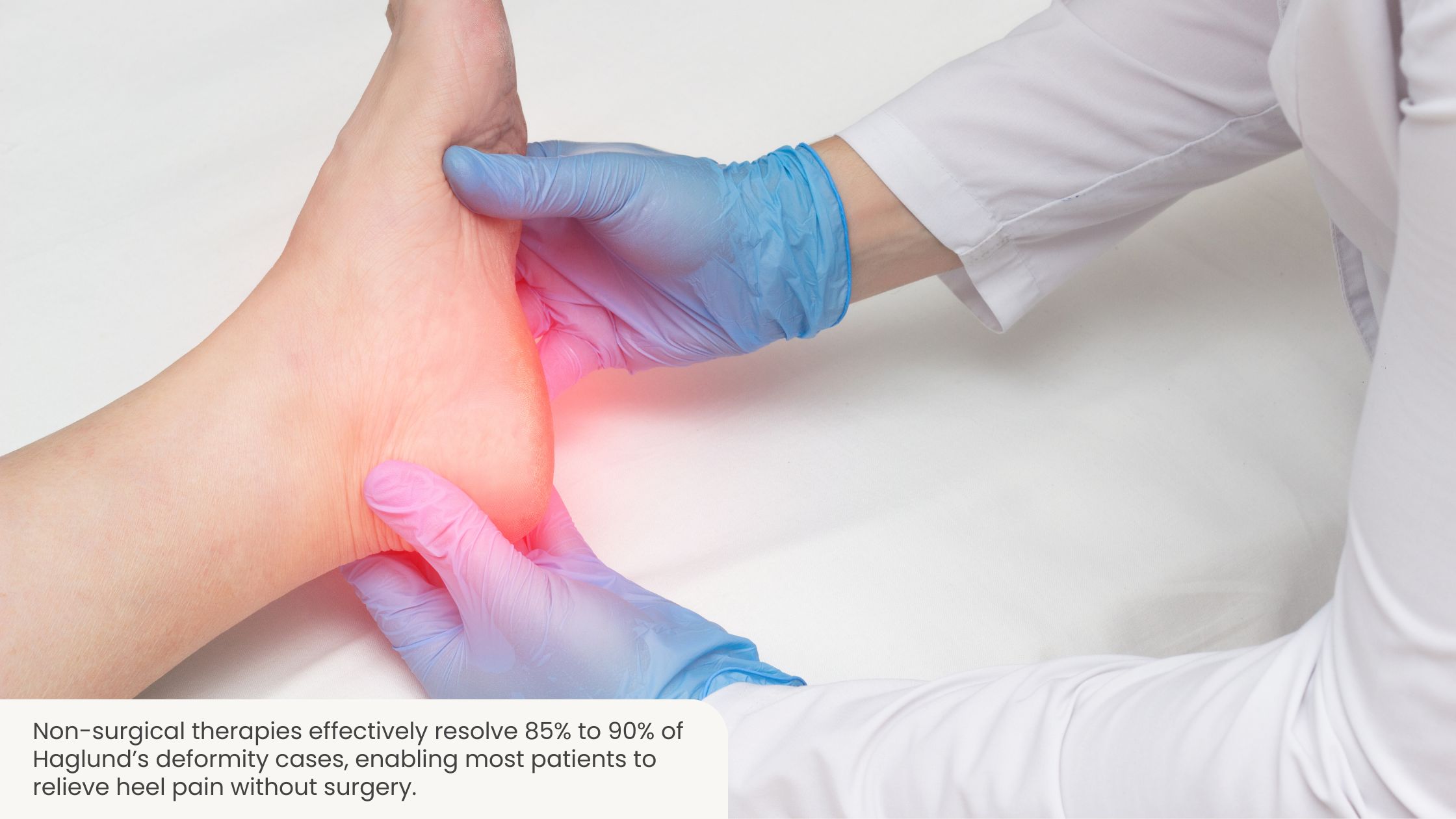
Why Is There A Painful Bump Behind Your Heel?
When you notice a hard, painful lump forming at the back of your foot, your mind naturally jumps to worst-case scenarios. In my orthopedic practice, I treat patients every week who suffer from this exact issue. They struggle to wear their favorite shoes, find walking painful, and wonder why a sudden bone protrusion has altered the shape of their foot.
If you are dealing with this discomfort, you are likely facing a condition known clinically as Haglund’s deformity, often called a “pump bump.”
Let us break down exactly what is going on with your foot, why it started, and how we can make the pain stop.
What is Actually Happening to Your Foot?
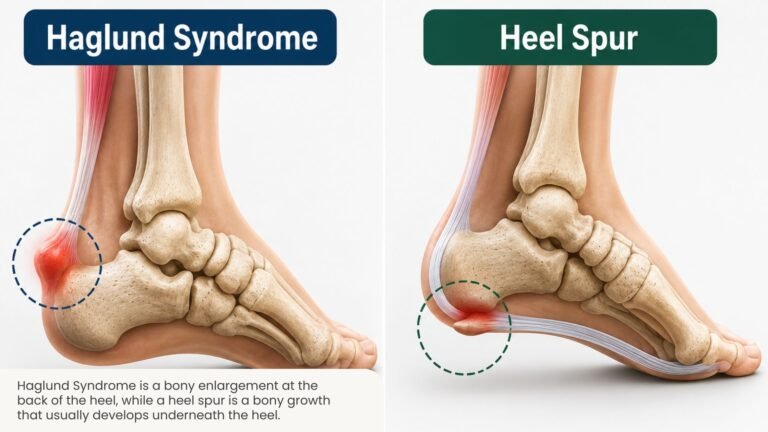
Many internet searches will tell you that a heel bump is just a standard bone spur. However, the anatomy is a bit more complex. Haglund’s deformity is an enlargement of the bony section of your heel bone (the calcaneus).
The bump itself is not always the direct source of your pain. The true discomfort stems from a mechanical “triple-threat” interaction involving three distinct structures:
- The Bone: The enlarged heel bone tissue itself.
- The Achilles Tendon: The thick band connecting your calf muscles to your heel.
- The Retrocalcaneal Bursa: A small, fluid-filled sac nestled between the bone and the tendon, designed to reduce friction.
When you walk, the bony growth continuously grinds against the bursa and compresses the Achilles tendon. This chronic friction triggers inflammation, causing a painful overlap of bone irritation, bursitis, and tendinitis.
Unlike plantar fasciitis, which hurts on the bottom of your foot, Haglund’s deformity strictly causes pain and swelling on the back of the heel.
Why Did This Bump Start?
While rigid-backed shoes, like stiff work boots, dress shoes, or high heels, are notorious triggers, they are rarely the sole cause. This condition usually starts due to a combination of your genetics and foot mechanics:
- High Foot Arches: If you have high arches, your heel bone is naturally tilted backward inside your shoe, which maximizes friction against the footwear.
- Supination: Walking on the outer edges of your feet forces the back of the heel to rub aggressively against the shoe counter.
- Chronic Calf Tightness: This is a major trigger that most generic articles completely ignore. When your calf muscles are tight, they pull upward on the Achilles tendon. This constant tension anchors the tendon flush against the enlarged heel bone, causing severe friction even when you walk barefoot.
How Do We Make the Pain Stop?
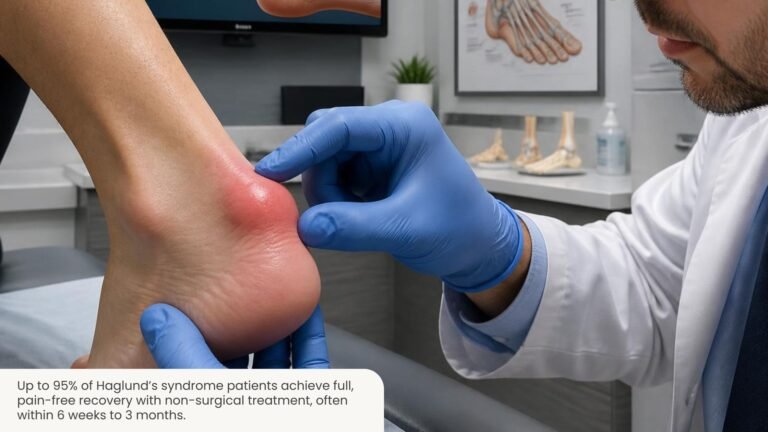
The good news is that up to 85% to 90% of patients find successful relief through conservative, non-surgical treatments. I always advise exhausting these non-invasive measures before considering surgical correction.
1. Modify Your Footwear Immediately
To give the inflamed bursa a chance to heal, you must remove external pressure. Temporarily switch to open-backed shoes, clogs, or soft mesh sneakers. If you must wear closed shoes, insert a temporary heel lift. This slightly alters the angle of your foot, shifting the bony prominence away from the rigid back of the shoe.
2. Lengthen the Calf Complex
To relieve the internal tension pulling the tendon against the bone, you need targeted stretching.
My Clinical Exercise Recommendation: Stand on the edge of a step. Raise up onto your toes using both feet, then slowly lower your injured heel below the level of the step over a slow count of 4 seconds. This eccentric loading lengthening relaxes the calf-tendon complex and reduces internal compression.
3. Explore Advanced Clinical Options
If lifestyle changes are not enough, I look to advanced therapies in the clinic. Custom orthotics can permanently correct your foot alignment to stop supination. We also utilize Extracorporeal Shockwave Therapy (ESWT), a non-invasive treatment that uses acoustic waves to stimulate blood flow and accelerate tissue healing.
When to Consider Surgery
If you experience debilitating pain that shows zero improvement after six consecutive months of dedicated conservative therapy, it may be time to discuss surgical intervention.
In these cases, I perform a calcaneal osteotomy to precisely shave down the prominent bony bump, remove the inflamed bursa, and repair any minor micro-tears in the Achilles tendon. Modern minimally invasive techniques allow us to do this with smaller incisions, which minimizes scar tissue and speeds up your recovery.
A painful heel bump is a mechanical issue, but you do not have to live with the daily frustration. By altering your footwear, stretching properly, and seeking a professional biomechanical evaluation, you can successfully reclaim pain-free steps.
Frequently Asked Questions
1. Can traditional Indian footwear cause this heel bump?
Yes. Rigid-backed footwear like traditional mojris, kolhapuris, or stiff formal dress shoes create intense, constant friction against your heel bone. If you already have a prominent bone structure, this repetitive rubbing quickly inflames the retrocalcaneal bursa, triggering the painful “pump bump.”
2. Should I walk barefoot at home if I have this bump?
I advise against it. Walking barefoot on hard tile or marble floors, common in Indian households, forces your calf muscles and Achilles tendon to work harder. This increased tension pulls the tendon tightly against the bony bump, worsening internal friction and inflammation. Wear supportive, soft-soled indoor slippers instead.
3. Will a warm water or Epsom salt soak help reduce the bump?
Soaks provide temporary, soothing relief for aching muscles, but they will not shrink the bump. Because Haglund’s deformity is a physical enlargement of the bone, it cannot be dissolved. To target the underlying inflammation, I recommend applying an ice pack for 15 minutes instead.
4. Which specialist should I consult in India for this condition?
You should consult an orthopedic surgeon or a podiatric specialist. I recommend seeking a practitioner who specializes in foot and ankle biomechanics. They can take weight-bearing X-rays to accurately measure your bone alignment and prescribe targeted physical therapy or custom orthotic insoles.
5. Can I cure this heel bump completely without surgery?
Yes, in the vast majority of cases. I successfully treat 85% to 90% of my patients using conservative methods. By permanently switching to soft-backed shoes, wearing custom orthotics, and consistently practicing eccentric calf stretches, you can completely eliminate the pain, even though the bony bump remains visible.