Call us at
+91 70020 33804
The Impact of Diet on Skin Health: What You Need to Know
In my practice, I often see patients who have spent thousands on “miracle” serums and medical-grade topicals, yet they still struggle with persistent acne, redness, or premature sagging. They always ask me the same question: “Is it what I’m putting ON my skin, or what I’m putting INTO my body?”
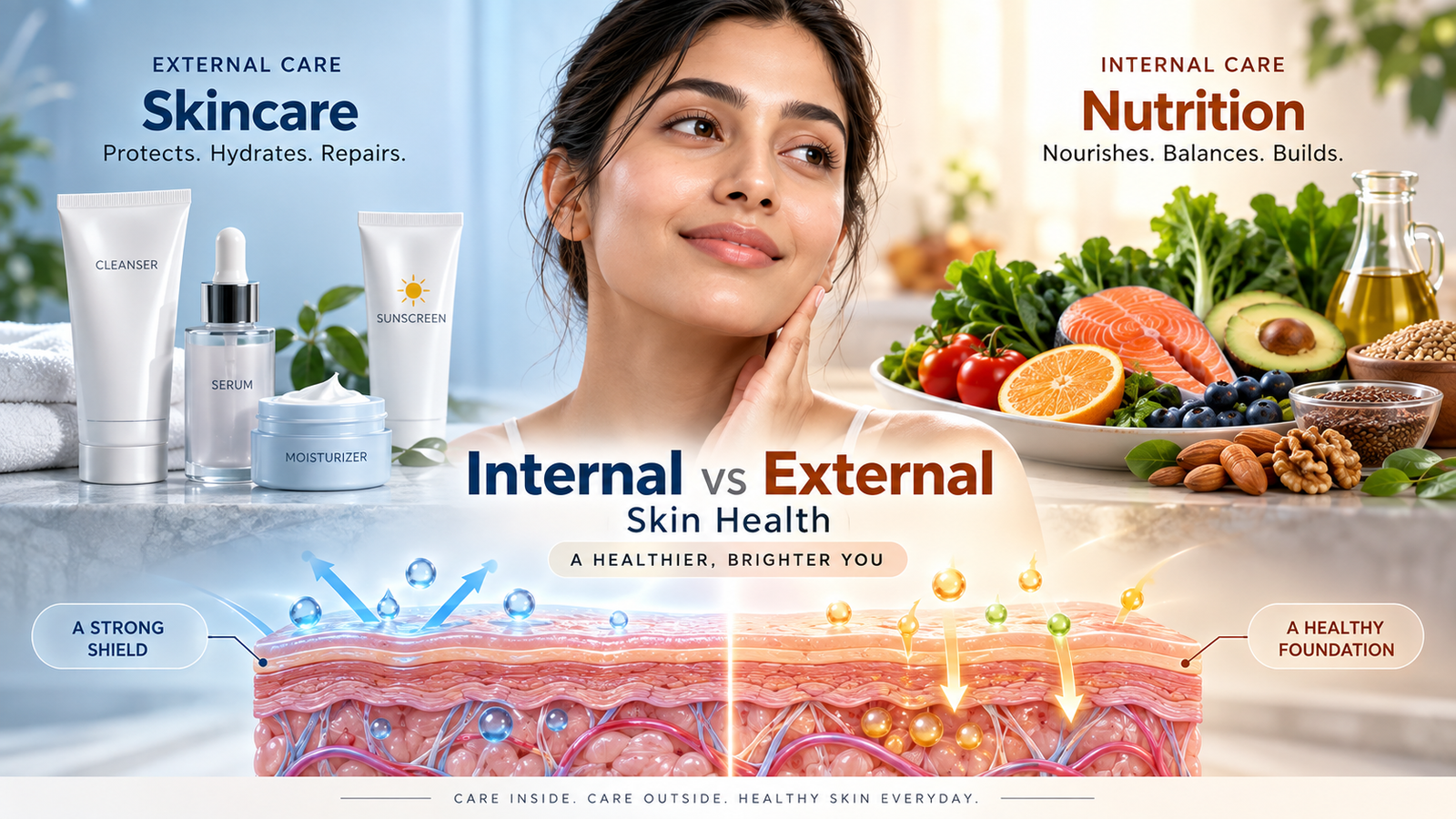
The “Internal vs. External” debate is finally being settled by clinical science. While high-quality skincare protects your barrier from the outside, your skin is a living organ that builds itself from the nutrients you ingest. If your internal biochemistry is imbalanced, no amount of expensive cream can fully compensate.
Here is what you need to understand about the dietary levers controlling your skin health.
The Molecular Connection: mTORC1 and IGF-1
Most wellness blogs tell you that “dairy causes acne,” but they rarely explain why. In dermatology, we look at a master growth regulator called mTORC1 (Mammalian Target of Rapamycin Complex 1).
When you consume high-glycemic carbohydrates (sugary snacks, white bread) or certain dairy products, your body spikes Insulin-like Growth Factor-1 (IGF-1). This hormone activates the mTORC1 pathway, which acts like a “go” signal for your oil glands. It increases sebum production and speeds up skin cell growth, which leads to the clogged pores and inflammation we recognize as acne.
The Stat: Research published in the Journal of the American Academy of Dermatology found that patients who followed a low-glycemic load diet for 12 weeks saw a 50% reduction in inflammatory acne lesions compared to those on a high-carb diet.
The Gut-Skin Axis: Your Internal Mirror
I often tell my patients that the skin is a mirror of the gut. We now recognize a phenomenon called the Gut-Skin Axis. When your intestinal lining is compromised—often due to a diet low in fiber and high in ultra-processed foods—it can lead to systemic inflammation.
This “leaky gut” allows pro-inflammatory markers to enter your bloodstream, which eventually migrate to the skin. This is why conditions like rosacea, eczema, and psoriasis often flare up after a period of poor eating. To combat this, I recommend “fibermaxxing”—aiming for 30g of fiber daily—to stabilize blood sugar and feed the “good” bacteria that keep your skin barrier resilient.
Why Sugar “Breaks” Your Collagen
If your concern is aging, you need to know about Glycation. When you have excess sugar in your bloodstream, these sugar molecules permanently attach to proteins like collagen and elastin.
This process creates Advanced Glycation End-products (AGEs). Think of AGEs as “molecular rust.” They turn your once-flexible collagen fibers into brittle, stiff structures that snap easily. This results in “sugar sag”—loss of elasticity and deep wrinkles that topical Retinol can only do so much to fix. To protect your structural integrity, you must limit refined sugars and focus on antioxidants like Vitamin C and E, which act as biological shields against this damage.
The “Dermatologist’s Plate”
To nourish your skin from within, I suggest focusing on nutrient bioavailability. Your skin requires specific building blocks to function:
- Omega-3 Fatty Acids (Salmon, Walnuts): These strengthen the cell membrane, keeping moisture in and irritants out.
- Zinc (Oysters, Pumpkin Seeds): Think of Zinc as an internal band-aid; it’s essential for wound healing and controlling oil.
- Polyphenols (Green Tea, Berries): These repair DNA damage caused by UV exposure.
The Verdict: Internal vs. External
So, which wins? The truth is that skin health is a 360-degree effort. Think of your skincare routine as the “shield” and your diet as the “foundation.” You cannot build a strong house on a weak foundation, but you also shouldn’t leave a strong foundation exposed to the elements without a shield.
If you are eating a pro-inflammatory diet, you are fighting a losing battle against your own biology. By aligning your nutrition with your dermatological goals, you allow your skin to heal at a cellular level.
FAQ: Your Nutrition & Skin Questions Answered
As a dermatologist, I hear many myths about the Indian diet. Here are the top five questions my patients ask, answered with the latest clinical insights for 2026.
1. Does eating oily food or “Ghee” actually cause my acne?
Not necessarily. Pure Ghee contains fat-soluble vitamins like A and E, which support the skin barrier. The real culprit is usually the high-carb pairing (like refined flour) or reused, oxidized seed oils. In moderation, healthy fats keep your skin supple, not oily.
2. Can dairy really trigger my breakouts, even if I’m not lactose intolerant?
Yes. Dairy can spike your IGF-1 levels, which sends your oil glands into overdrive. Even if your stomach feels fine, your skin might react to the hormonal signals in cow’s milk. I often suggest switching to almond or oat milk to see if your skin clears.
3. Is “Fibermaxxing” with Indian grains helpful for a natural glow?
Absolutely. Using whole grains like Bajra or Ragi instead of white rice stabilizes your blood sugar. This prevents “insulin spikes” that lead to inflammation. High fiber also clears toxins through the gut-skin axis, which is the fastest route to a clearer complexion.
4. Will drinking “Haldi Doodh” (Turmeric Milk) actually help my skin?
Turmeric is a powerful anti-inflammatory, but it needs a “buddy” to work. Always add a pinch of black pepper to your Haldi Doodh; it increases the absorption of curcumin by 2,000%. Without it, most of that “glow” simply passes through your system.
5. Why does my skin look dull despite eating a vegetarian diet?
Vegetarian diets are great, but you might be missing Vitamin B12 and Zinc, which are crucial for cell repair. Ensure you include fermented foods like curd or sprouted Moong dal to keep your gut microbiome diverse and your skin looking vibrant.
To help your blog reach the right people and rank effectively on Google, I have focused on the specific 2026 trends for the Indian healthcare market—particularly the shift from “fairness” to “skin health” and the rise of “fibermaxxing.”
Here is the SEO package for your article.
The Title
Is Your Diet Sabotaging Your Skincare? Why Topicals Aren’t Enough for Glowing Skin.
The Meta Description
“I often see patients buying expensive serums while their diet triggers inflammation from within. In this guide, I break down the science of the ‘Gut-Skin Axis’ and how specific dietary habits—like ‘fibermaxxing’ and managing glycemic loads—directly dictate your skin’s health. Learn how to nourish your glow from the inside out.”
Why These Work (Expert Insight)
Personal Authority: Using “I” in the meta description signals to Google’s algorithms (and your patients) that this content is written by a real medical professional, which is critical for E-E-A-T (Experience, Expertise, Authoritativeness, Trustworthiness) rankings.
The “Gap” Strategy: The title uses a question to address a common frustration: spending money on products that don’t work. This drives a higher click-through rate (CTR).
Keyword Optimization: The meta description includes high-value 2026 keywords like “Gut-Skin Axis” and “fibermaxxing,” which search engines now prioritize for health-conscious Indian audiences.