Call us at
+91 70020 33804

Haglund Syndrome Vs Heel Spur: What Is The Difference?
As an orthopedist, I treat busy, active professionals every single day who walk into my clinic with a single, clear complaint: “Doctor, my heel hurts so much that it is dictating how I live my workday.”
Heel pain is incredibly common, but a major point of confusion for my patients is figuring out exactly what is causing it. Two conditions that I frequently diagnose, and that patients almost always mix up, are Haglund’s Syndrome and Heel Spurs.
Because both conditions involve an abnormal bony growth on the heel bone (calcaneus), it is easy to see why people confuse them. However, they occur in entirely different parts of the foot, stem from distinct biomechanical issues, and require completely separate treatment approaches. The definitive way to tell them apart is by looking at the exact location of the pain and what it feels like.
1. Where Exactly Is the Pain Located, and What Does It Feel Like?
When I evaluate your foot in my clinic, the geographic location of your pain is the immediate giveaway.
Haglund’s Syndrome: The Back of the Heel
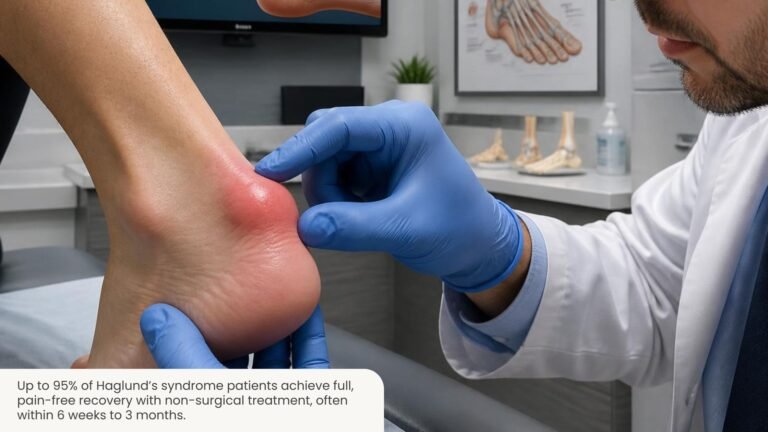
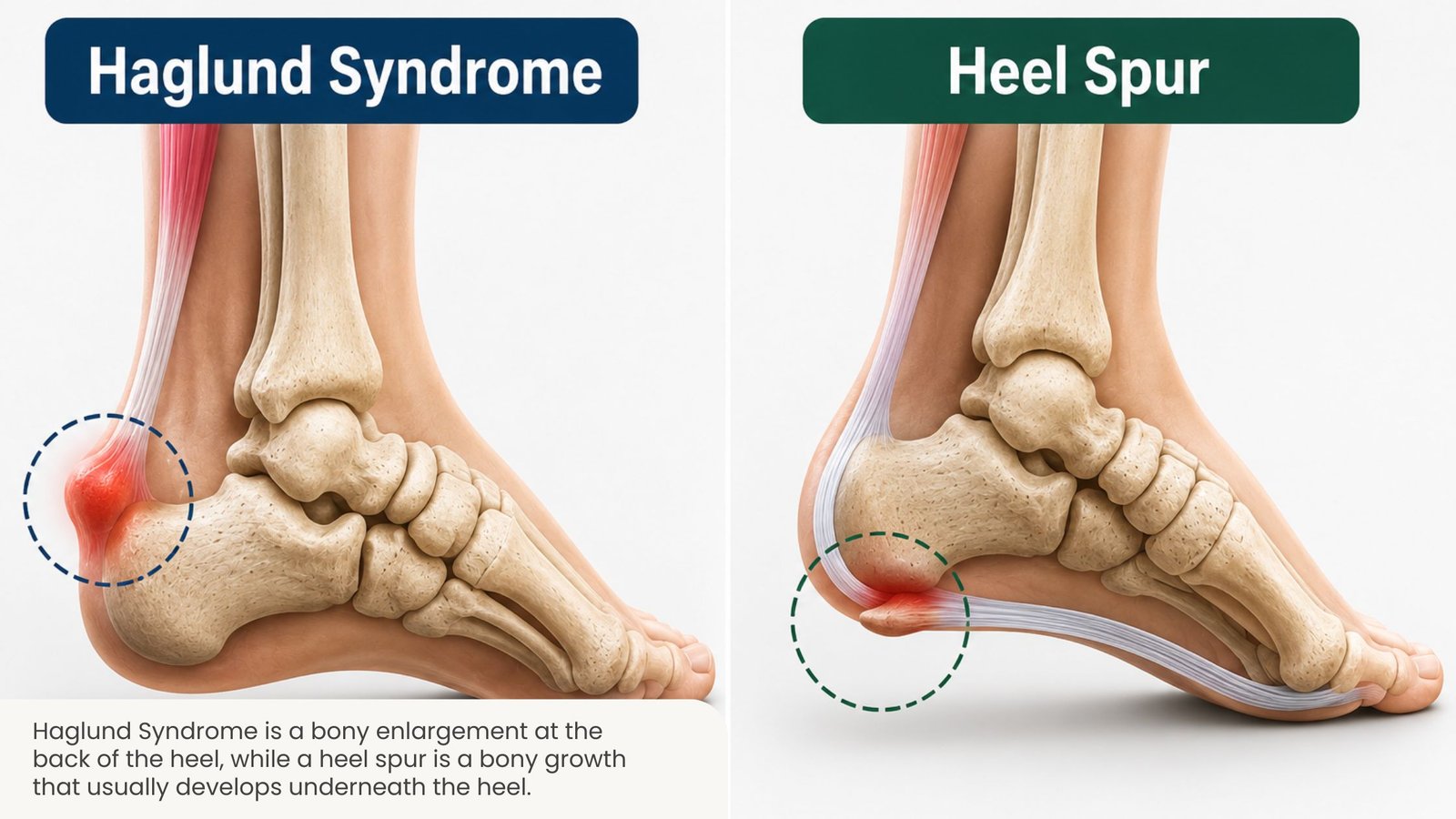
If you are dealing with Haglund’s syndrome, your pain is strictly located at the posterosuperior aspect, the very back of your heel bone, right where your Achilles tendon anchors.
- What it feels like: It manifests as a constant, deep ache or a sharp, burning sensation when friction occurs. You will likely see and feel a visible, hard, red bump. This bony prominence rubs against the rigid back of your footwear, causing the surrounding soft tissues to inflame. This results in a painful combination of insertional Achilles tendinitis and retrocalcaneal bursitis (inflammation of the fluid-filled cushioning sac behind the bone).
Heel Spur: The Bottom of the Heel
Conversely, a traditional heel spur develops on the inferior aspect, the underside of your heel bone.
- What it feels like: This feels like a sharp, stabbing knife directly underneath your foot when you bear weight. Interestingly, a clinical study on calcaneal spurs notes that these bony calcium deposits are actually a protective skeletal response to chronic plantar fasciitis (inflammation of the thick band of tissue supporting your arch).
2. Tracking Your Symptoms Across a Workday
The way your pain behaves throughout a busy day tells me a lot about your diagnosis.
If you have a Heel Spur, your absolute worst pain occurs during your very first steps out of bed in the morning or after sitting at your office desk for a long time. The plantar fascia ligament tightens up while you rest; when you suddenly stand, it stretches violently against the bone where the spur is located. The pain often dulls into a manageable ache after a few minutes of walking, though it returns by evening.
If you have Haglund’s Syndrome, your pain is triggered directly by your shoes. It might feel fine when you are barefoot in the morning, but the moment you step into rigid dress shoes, pumps, or stiff work boots, the friction begins. The pain gets progressively worse toward the end of a long shift or a commute as the constant rubbing builds up inflammation.
3. The Overlooked Biomechanical Causes
Most health blogs claim that bad shoes alone cause these issues. While footwear matters, the underlying mechanics of your legs are the true culprits.
Your heel is the anchor point for your entire lower leg’s kinetic chain. A tight calf muscle complex (gastrocnemius and soleus) limits your ankle’s flexibility. When you walk with tight calves, your body forces a compensatory movement. If that stress pulls on the
Achilles tendon insertion, it accelerates a Haglund’s enlargement. If that stress transfers to the bottom of the foot, it yanks on the plantar fascia, creating a heel spur.
Furthermore, your inherited foot architecture plays a role. High arches naturally tilt your heel bone backward into the Achilles tendon, driving Haglund’s friction. Flat feet cause your foot to roll inward, overstretching the bottom ligament and triggering a heel spur.
4. My Approach to Treatment
I always emphasize to my patients that we treat the person, not just the X-ray. In fact, clinical data shows that nearly 30% of heel spurs are completely asymptomatic and are discovered purely by accident. We must treat the soft-tissue inflammation, not just the bone shape.
| HAGLUND’S SYNDROME (Back of Heel) | HEEL SPURS (Bottom of Heel) |
| Pain at back of heel with shoesVisible red bump (“pump bump”)Treatment: Open-back footwear, eccentric Achilles stretches, temporary heel lifts | Sharp, stabbing morning pain under the footTreatment: Custom orthotics with a heel cutout, plantar fascia stretch, night splints |
I always exhaust non-invasive, conservative care for at least six months before discussing surgical interventions. If you are experiencing persistent heel pain that interferes with your mobility, I highly recommend scheduling a formal evaluation. Pinpointing the exact location and cause of your pain is the crucial first step to getting you back on your feet comfortably.
Frequently Asked Questions
1. Does walking barefoot on marble or tiled floors at home make my heel spur worse?
Yes, I see this daily. Walking barefoot on hard, uncarpeted Indian flooring like marble, granite, or vitrified tiles strips away your foot’s natural shock absorption. This directly increases repetitive impact on your heel bone, drastically worsening the sharp, stabbing pain of an underlying heel spur.
2. Can traditional Indian footwear like flat juttis, mojris, or rubber slippers trigger Haglund’s syndrome?
Absolutely. Traditional juttis and mojris feature notoriously stiff, rigid leather back counters that rub relentlessly against your Achilles tendon insertion. Alternatively, cheap, flat rubber slippers lack any structural arch support. This architectural combination forces abnormal strain on both the back and bottom of your heel.
3. Will home remedies like warm mustard oil massages or Epsom salt soaks cure my heel pain?
While I understand these traditional remedies offer temporary comfort by increasing localized blood circulation, they cannot structurally cure a bony deformity. They merely soothe the superficial soft-tissue inflammation. To resolve the underlying mechanical issue, you still require a tailored orthotic or targeted physical therapy.
4. My heel pain gets much worse during the monsoon season. Is this related to my bone growth?
The changing weather itself does not make the bone grow larger. However, during the Indian monsoon, many of my patients switch to flat, unsupportive waterproof footwear or modify their walking style to avoid slipping. This sudden shift alters your gait biomechanics, causing acute flare-ups in the surrounding soft tissues.
5. If I have diabetes, does a heel spur or Haglund’s syndrome require extra medical caution?
Yes, I advise extreme caution. Diabetes compromises your microvascular circulation and peripheral nerve function, which significantly delays healing in your feet. Any chronic skin friction from a Haglund’s bump or structural strain from a heel spur can rapidly progress into a serious, non-healing foot ulcer if left untreated.