Call us at
+91 70020 33804

Can Haglund’s Syndrome Heal Without Surgery? An Orthopedist’s Guide
As an athlete or active individual, hearing that you have Haglund’s syndrome can feel like a setback. When a painful, bony bump forms on the back of your heel, your mind immediately jumps to the worst-case scenario: an operation, months of crutches, and a long break from training.
The question I hear most often in my clinic is simple: Is surgery avoidable for this type of heel pain?
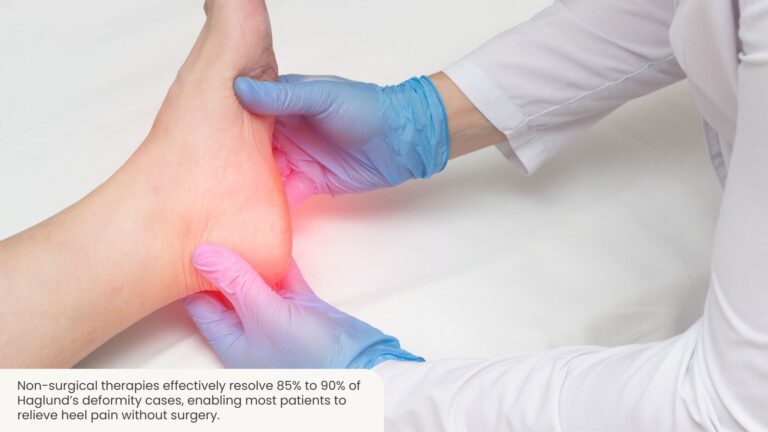
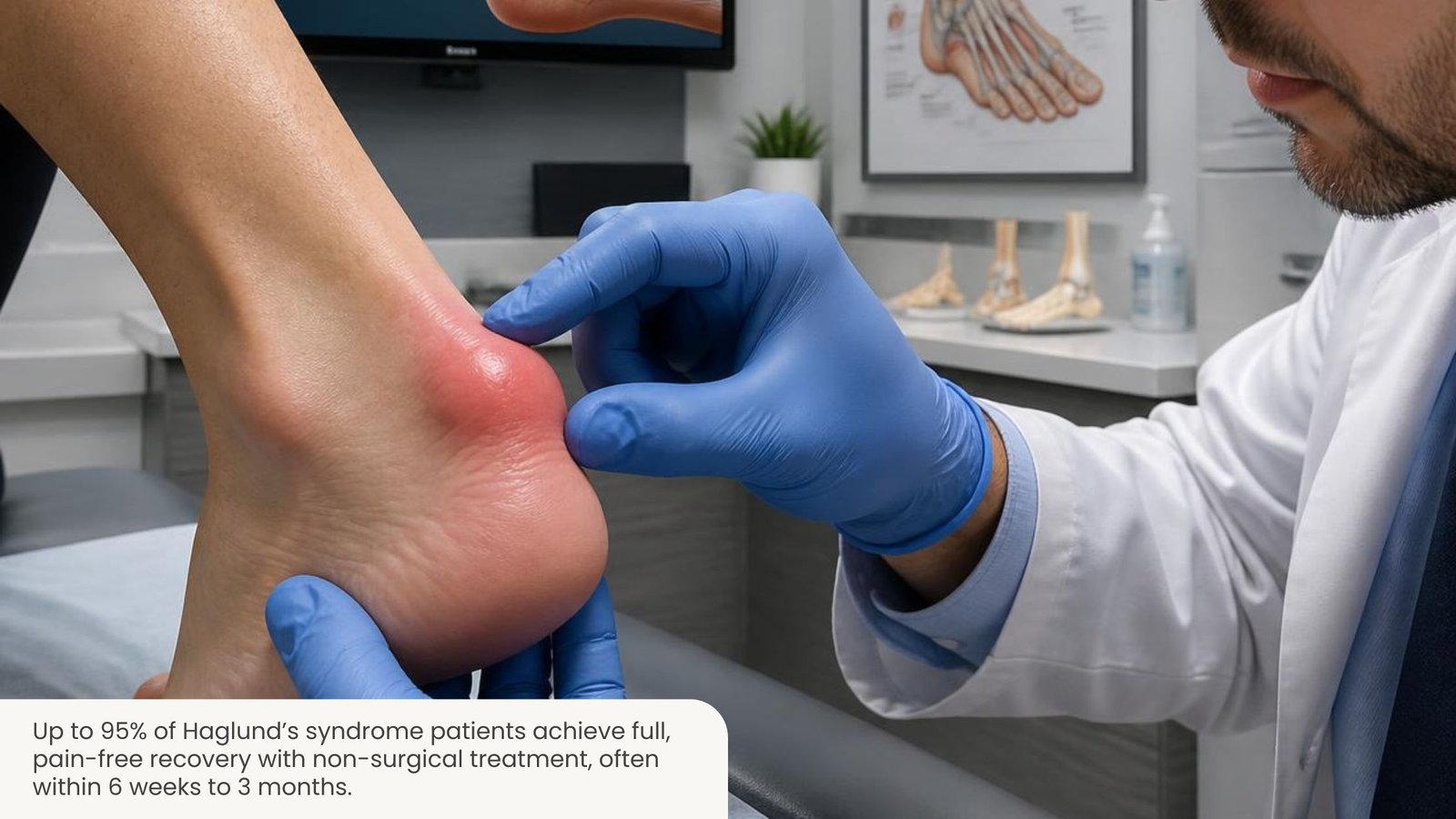
The short answer is yes. Clinical data consistently shows that 85% to 95% of patients with Haglund’s syndrome successfully recover using non-surgical methods alone.
However, avoiding surgery requires understanding what “healing” actually means for this condition, alongside a strategic approach to rehabilitation.
What Does “Healing” Actually Mean?
To successfully treat this condition without surgery, we must establish a critical clinical distinction. I tell my patients that we are aiming for symptomatic healing, not structural healing.
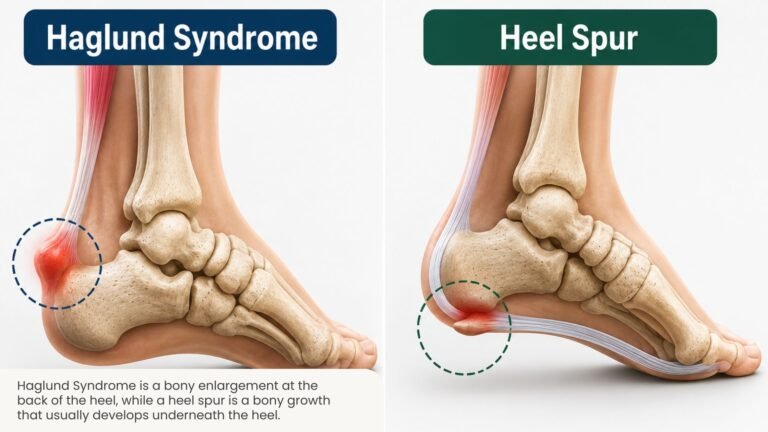
Haglund’s syndrome is fundamentally an impingement injury. The physical, bony enlargement on your heel bone (the calcaneus) will not vanish without an operation. However, the bone itself isn’t what causes your pain. Your discomfort stems from the bone constantly compressing and irritating the soft tissues around it—specifically the retro calcaneal bursa (a fluid-filled sac) and the Achilles tendon.
[Bony Prominence] ➔ Compresses ➔ [Bursa & Achilles Tendon] ➔ Causes Inflammation & Pain
Healing means completely eliminating that soft-tissue inflammation and swelling. Once we calm the bursa and restore health to the tendon, you can live and compete entirely pain-free, even though the structural “bump” remains.
The Non-Surgical Rehabilitation Roadmap
If you want to bypass the operating room, you cannot rely on passive rest alone. I utilize a structured, active rehabilitation protocol designed to offload pressure and rebuild tissue resilience.
1. Active Load Management
I rarely tell athletes to stop moving entirely; instead, I prescribe relative rest. We must temporarily reduce activities that force your ankle into deep dorsiflexion (bending your foot upward), which aggressively smashes the soft tissue against the bone bump. I recommend swapping high-impact running for low-impact conditioning, such as swimming, aqua jogging, or cycling with low resistance.
2. Biomechanical Offloading
We must alter the forces acting on your heel. I frequently recommend a temporary 12mm to 18mm heel lift placed inside your athletic shoes. Clinical studies confirm that elevating the heel shifts your weight forward, significantly reducing peak strain on the Achilles tendon and minimising friction against the bursa.
Additionally, look closely at your footwear. If you wear running shoes with rigid heel counters, the stiff backing will continuously compress the injury. Switch to open-back shoes or modern athletic trainers featuring soft, knit heel collars.
3. Progressive Tissue Loading
Once the acute inflammation subsides, we must strengthen the area. Rather than aggressively stretching a hot, irritated tendon, I prescribe heavy slow resistance (HSR) training and eccentric heel drops on a flat floor. This controlled loading triggers cellular repair and conditions your Achilles tendon to handle high-impact forces safely.
Two Mistakes That Will Delay Your Recovery
In my practice, I find that many chronic cases fail conservative care because of two specific pitfalls:
- The Cortisone Danger: I strongly advise against receiving cortisone injections into the retro calcaneal space. While cortisone is a powerful anti-inflammatory, injecting it near a major weight-bearing tendon significantly elevates the risk of a catastrophic Achilles tendon rupture.
- The Zero-Drop Shoe Trap: Many runners love minimalist or zero-drop shoes. However, for a Haglund’s patient, a flat shoe forces the ankle into an extended range of motion, aggravating the impingement. Avoid zero-drop footwear until you are entirely asymptomatic.
The Timeline: When Can You Expect Results?
Soft tissue healing takes time. If you remain strictly compliant with load management, physical therapy, and shoe modifications, you can expect noticeable pain reduction within 6 weeks to 3 months.
I clear my patients to return to full sport once they can perform 30 single-leg heel raises without pain and no longer experience stiffness in the morning.
When Is Surgery Actually Necessary?
I only consider surgical intervention as a last resort if a patient derives no relief after 3 to 6 months of dedicated, compliant conservative care.
If you fall into that small percentage, take comfort in knowing that modern orthopaedic surgery offers highly effective, minimally invasive endoscopic options to shave down the bone bump. The procedure boasts a satisfaction rate near 94%, allowing athletes a smooth return to the field.
Ultimately, your bone bump is not a sentence for surgery. With the right biomechanical adjustments, you can achieve complete healing and return to peak performance.
Frequently Asked Questions (FAQs)
1. Can I wear regular formal shoes or leather boots if I have Haglund’s syndrome?
I advise against wearing rigid, stiff-backed leather shoes or formal boots. The hard heel counters continuously rub and compress the bone bump, worsening inflammation. Instead, choose soft-backed formal wear, semi-formal knit shoes, or shoes with open heels to safely offload the pressure.
2. What is the approximate cost of Haglund’s syndrome surgery in India?
If conservative care fails, a minimally invasive or endoscopic calcaneoplasty surgery in India typically costs between ₹60,000 and ₹1,500,000. The exact price varies depending on the city, the choice of hospital, and whether any accompanying Achilles tendon repair is required.
3. Will home remedies like warm water soaks or turmeric help dissolve the bump?
Home remedies cannot dissolve or shrink the physical bone bump. However, I often find that warm water soaks or applying natural anti-inflammatory pastes can temporarily soothe the surrounding muscles. For true, lasting pain relief, you must focus on mechanical offloading and physiotherapy.
4. Can yoga or specific stretches cure this heel pain?
Yoga poses that stretch the posterior chain—like Adho Mukha Svanasana (Downward Dog)—help reduce calf tightness, which relieves tension on the Achilles tendon. While yoga cannot “cure” the structural deformity, it serves as an excellent tool to manage symptoms and prevent future flare-ups.
5. Why is my heel pain worse in the morning, and how do I manage it?
Your Achilles tendon naturally tightens and shortens overnight while you sleep. When you take your first steps in the morning, the sudden stretch causes intense pain. I recommend performing gentle ankle rotations and calf stretches in bed before putting your feet on the floor.